






The Ultimate Guide to Smart Soil Monitoring
Introduction
Keeping plants healthy is more than just a weekly watering routine; it’s about understanding the invisible environment of the soil. Whether you are managing a delicate indoor fern or a home greenhouse, choosing the right sensor is the difference between a thriving garden and root rot.
1. Capacitive vs. Resistive: Why Technology Matters
Not all soil sensors are created equal. The technology used to measure moisture determines how long your sensor will last.
-
Resistive Sensors: These use two exposed metal probes to pass electricity through the soil. The Problem: They are prone to electrolysis and corrosion. Over time, the metal degrades, leading to inaccurate readings and a short product lifespan.
-
Capacitive Sensors (Our Choice): These sensors do not have exposed metal electrodes. Instead, they use a capacitive measurement to detect the dielectric constant of the soil.
-
Longevity: Since the "probes" are coated, they don't corrode.
-
Accuracy: They provide more stable readings over time without "polluting" the soil with metal ions.
-
2. Zigbee vs. WiFi: Which Protocol is Best?
For smart home enthusiasts, the protocol is just as important as the sensor.
| Feature | Zigbee | WiFi |
| Battery Life | Ultra-Long (Years) | Short (Months/Weeks) |
| Congestion | Low (Mesh Network) | High (Shares bandwidth with phones/TVs) |
| Reliability | High (Works locally without Cloud) | Dependent on Router/Internet |
| Range | Greatly extended via Mesh | Limited to Router signal |
The Verdict: Because soil sensors are battery-powered, Zigbee is the superior choice. WiFi is too power-hungry for a device that needs to sleep and wake up to report data, whereas Zigbee allows our sensor to run for a year or more on a single battery.
3. Understanding IP44: Placement Tips
Our Zigbee Soil & Air Temperature sensor is designed with an IP44 rating. Here is how to ensure its longevity:
-
The "Rain-Proof" Rule: It can handle water splashes from above (like when you are watering your plants with a can).
-
Indoor & Semi-Protected Use: It is perfect for indoor pots, grow tents, and covered porches.
-
What to Avoid: Do not submerge the sensor or leave it in open outdoor areas where heavy rain can saturate the casing. It is not designed for full outdoor exposure or irrigation zones where water might pool.
4. How to Choose the Right Sensor for Your Setup
When shopping for a sensor, look for these three pillars:
-
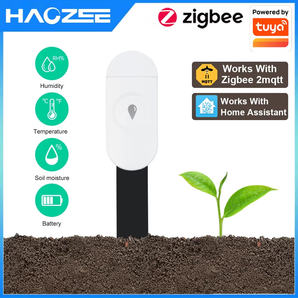
Integration: Does it support Zigbee2MQTT or ZHA? (Our sensors are fully compatible with Home Assistant).
-
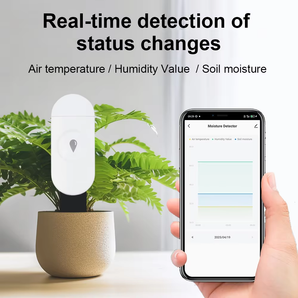
Dual-Purpose: Does it measure both soil moisture and ambient air temperature/humidity? Getting all three data points from one device saves you money and hub space.
-
Build Quality: Ensure it uses a capacitive probe to avoid the "buy-it-replace-it" cycle of cheap resistive sensors.